Cultural Couture in Devil Wears Prada

Updated: Dec 8, 2025
Ever since I was a little girl, I have been obsessed with movies that Anne Hathaway is in. Literally think of Ella Enchanted, Bride Wars, etc. You name a movie that she was in; its probs one of my favorites. Its been since I was a kid, I loved watching feisty TV. When my mother introduced me to this movie, I was absolutely enamored by its campness.
Early in The Devil Wears Prada, there’s a moment every fashion lover remembers: Miranda Priestly’s cold 'That’s all.' Those two words say so much about power, taste, and style. For me, that line—and the whole movie—has become a cultural touchstone. It’s more than just the clothes; it’s about how fashion shapes identity, how media influences that world, and how women balance ambition and authenticity in a society focused on image.
Watching The Devil Wears Prada again, as a communications student who hopes to work in luxury fashion PR, feels like unlocking a language I’ve always understood. Every outfit, headline, and sharp comment from Miranda is full of meaning, the kind that communication majors enjoy analyzing and PR professionals know how to use. If you, dear reader, have had the pleasure of witnessing anyone describe The Devil Wears Prada as "just a fashion movie," you already know what I'm about to say next, I'm sorry. That's genuinely tragic. Because TDWP is not just a movie; its cultural text, a piece of aesthetic scripture, a masterclass in PR messaging disguised as a montage of Meryl Streep blinking disappointingly. It's also the gay Roman Empire, except think of switching out the battles and Trojan horses for cerulean sweaters, Chanel boots, and Anne Hathaway shedding her ugly-duckling bangs like it's a spiritual REBIRTH.
I digress because I could go on and on and on about how the movie set her up for failure from the get-go, yada yada. Let's get into three looks that didnt just change Andy Sachs; they changed US (or maybe just me for that matter...). They moved into the city of PR and made themselves permanent residents, living rent-free in my mind since their debut.
CERULEAN SWEATER (I'm still at the restaurant..)
Ah yes, the Cerulean sweater, the soft, slightly shapeless knit that shook the fashion industry. Andy comes into Runway wearing this bargain bin sweater, blissfully unaware that she's basically spitting directly onto the altar of high fashion and insulting Mother Teresa whilst we speak. Miranda hits her with the "lumpy blue sweater monologue," you know the one, where she dismantles Andy's entire personality, self-worth, and grasp on late-stage capitalism using just the word CERULEAN. The color’s journey, from Oscar de la Renta’s runway to a clearance bin at Casual Corner, shows how fashion and culture move through layers of influence and control. This is communications theory in action: fashion as a message shaped by media. Everything is planned. This scene was the moment that shook the fashion PR mainstream as we know it. It taught the general public a few lessons that, often, I fear we are forgetting today.
Fashion is not silly, rather it is a billion dollar ecosystem that dictates and predicts what everyone is wearing, if not that, what they will wear flash foeward a couple months and years..
Even the guy we see walking down State Street, with the cargo shorts, and the Xbox headset has been influenced by the runway (but he'll insist that he finds fashion stupid and doesnt care, bless his heart)
PR messaging and intentionality, is the real wizards behind the curtain. Cerulean didnt just "happen"; it was pushed, positioned, and executed in a very specific manner to create change, and send a message to the world (and even your dentist wearing it on casual Friday...).
The cerulean sweater, although sometimes painful to look at, was patient zero for mainstream fashion literacy. A cozy little Trojan horse that made people realize... oh! fashion is actually power.

ANDY'S TRANSFORMATION
Let's make something very clear; if our cerulean sweater was the thesis statement, Andy's glow up montage was the Broadway show debut. The moment she steps off the elevator, in the chanel boots, yes you know the ones, the ones that whisper "I'm booked and busy and ocassionally drink espresso for dinner", we hear a pin drop. The entire office stops breathing, and the world is SHOOK. Because fashion PR is about storytelling, and Andy's boots told a very simple, yet effective story. "I am not a woman who knows what a sample closet is"
This montage didn't just give us looks; it gave us the very blueprint for the catalyst that would become 2000s rom-com fashion montages. Fashionable gay saves woman in crisis, Dr takes assistant on fashion spree (yes that scene in Just Go With It changed my life, I love you Jennifer Aniston), and the concept that a great outfit can fix 80% of your problems (the other 20% are that boyfriend.. but we'll get to that later).
These looks—the tweed coats, the oversized sunnies, and the bangs that somehow became a personality trait—all became iconic reference points for fashion salvation. They were aspirational content before Instagram walked the earth. Every PR girl, fashion student, and woman who has ever needed to "look competent" in public, has pulled at least one Andy montage outfits for inspiration. Andy's glow up became the universally acknowledged language of character transformation through styling. And honestly? Cinema hasnt topped it since.

MIRANDA PREISTLEY'S ALL BLACK COAT AND SUNGLASSES. THE LOOK THAT LAUNCHED A THOUSAND PITCH DECKS.
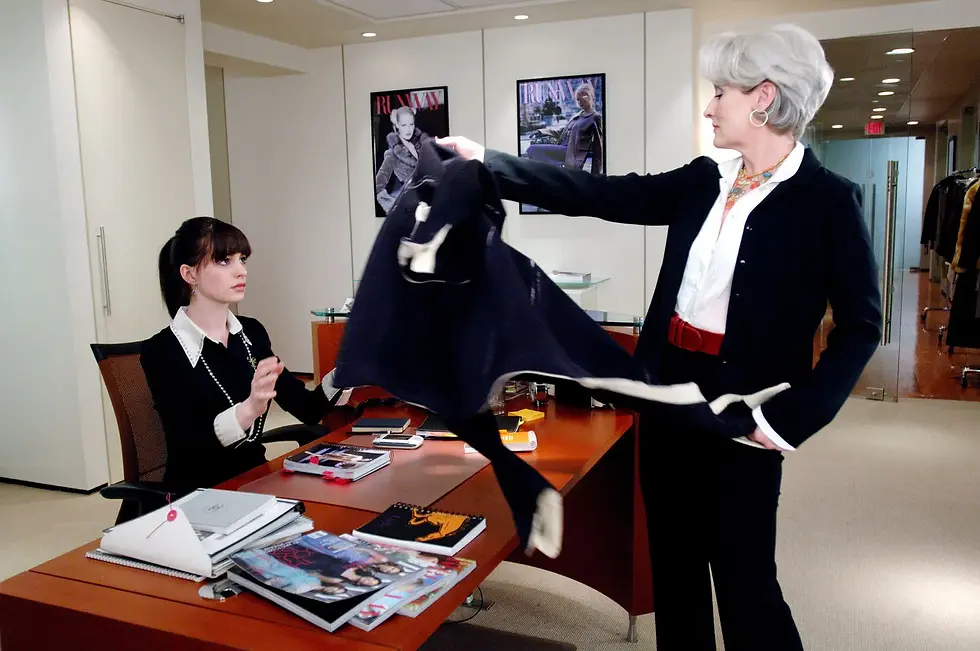
Miranda Priestly. A name so iconic it sends shivers down my spine. Her fur lined black coat and sunglasses, the one she shrugs into cars, drops onto desks, and swishes down hallways like she's parting the Red Sea, are easily top three most recognizable fashion-movie outfits in the past two decades.
This isnt just an outfit.. its a brand identity. Miranda in all black is the embodiment of;
authority without raising your voice
PR messaging so precise it could cut glass
the icy confidence required to terrify grown adults into rewriting a press release at 1am
Fashion PR professionals (including my previous bosses), still reference Miranda because she represents the aesthetic of controlled sophistication. She taught me the power of monocrhome dressing, structured sihlouttes, sunglasses indoors (a power play, a faux paus), and a coat that doubles as emotional armor. This fit infiltrated pop culture SO DEEPLY that even people who have never seen the movie know the vibe, and the historical significance behind the whole moment. Every woman on the Q train at 8:30am wearing a black coat is cosplaying Miranda Priestly whether she realizes it or not. Fashion PR still uses this look as a visual shorthand for excellence, command, and fashion domination that says "I will destroy you in a very chic way"

Significance of all of it
So you may be wondering, Sam.. you just blabbed on for so long, but whats the point of all of it? These looks matter because each one is Fashion PR disguised as character development. These outfits all influenced how we talk about fashion, understand branding, how we recognize the labor behind aesthetics, how women in communications cultivate their power (often times through clothing). These looks and this film emphasize how clothing is communication, style is strategy, and fashion is a language where its spoken fluently within Devil Wears Prada. This film proved that fashion in film can shape real world culture in a way a that only a few things can. Straight men have sports, some have the roman empire..
We?
We have Miranda Priestly removing her coat and causing an entire generation to major in PR. Including me!


Comments